Case Spotlight: Passenger Vehicle Drive Shaft Modal Test
Jul 15,2025
I. Overview
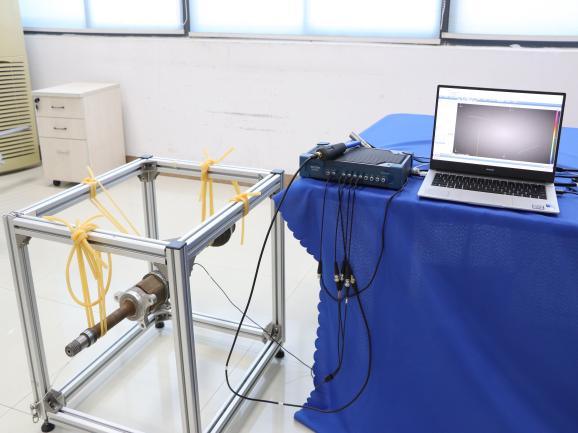
This test employed EconTest software for impact hammer testing and MIMO FRF testing modules to conduct modal analysis on a passenger vehicle drive shaft. Exciter method tests were performed under both free-free and constrained-end boundary conditions. The process involved: simplified modeling of the drive shaft, sensor (exciter) deployment, and result analysis to determine first-order modal parameters: natural frequency, damping ratio, and mode shape.
Test Conditions:
1. Exciter method with free-free boundary
.jpg)
2. Exciter method with constrained-end boundary
.jpg)
II. Test Equipment
|
No. |
Equipment |
Model |
|
1 |
Dynamic Signal Analyzer |
ECON MI-7208 |
|
2 |
Vibration Exciter |
ECON VE-5110M |
|
3 |
Force Sensor |
CL-YD-331 |
|
4 |
Charge Amplifier |
ECON MI-2004A |
|
5 |
Uni-axial Accelerometer |
EV1100 / PCB |
|
6 |
Tri-axial Accelerometer |
EV4540 |
.jpg)
III. Test Data & Analysis
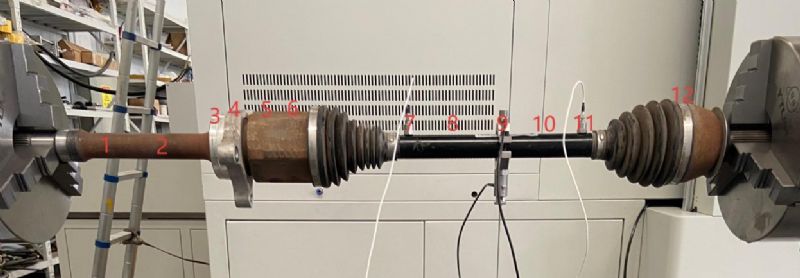
1. Measurement Points
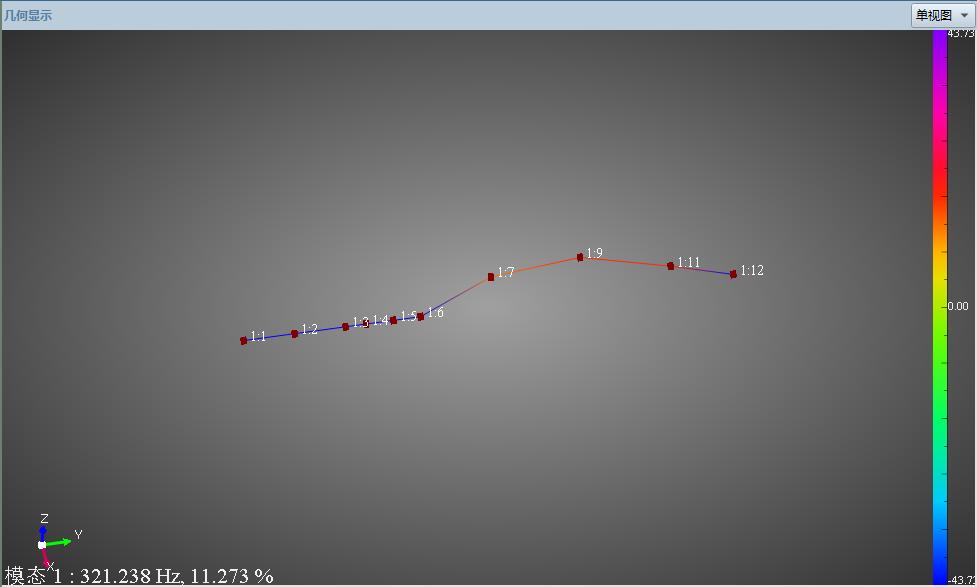
① Free-Free Boundary Condition
Results: Natural frequency = 321 Hz
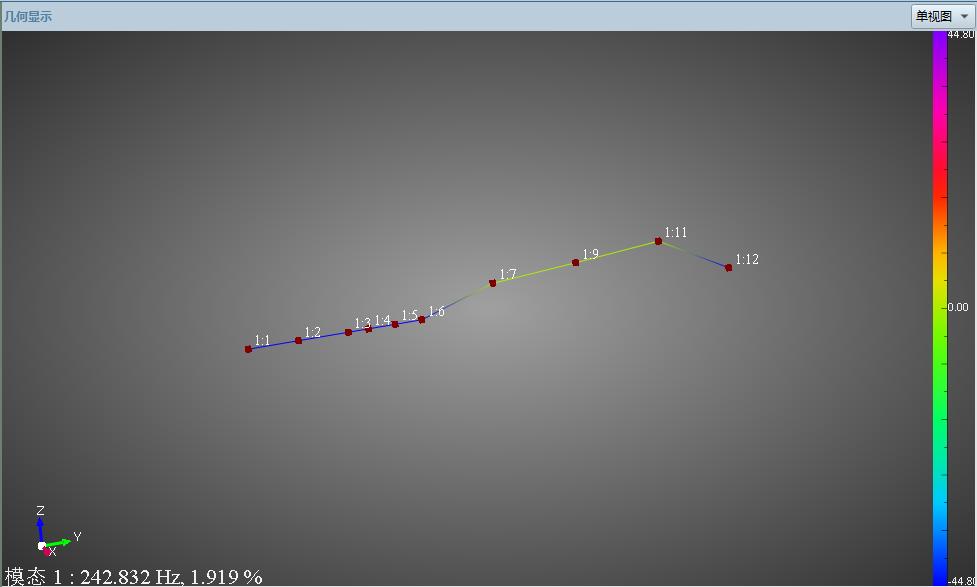
② Constrained-End Boundary Condition
Results: Natural frequency = 242 Hz
IV. Conclusion
Comparative testing revealed:
The natural frequency measured under free-free boundary conditions (321 Hz) is 32.7% higher than under constrained-end conditions (242 Hz).