Modal Characterization of a Passenger Vehicle Drive Shaft Under Free-Free and Constrained-End Boundary Conditions
Nov 20,2025
Abstract
Boundary conditions play a critical role in the dynamic behavior of automotive driveline components. This study presents an experimental modal analysis of a passenger vehicle drive shaft using impact and exciter-based frequency response function (FRF) measurements. Two boundary conditions—free-free and constrained-end—were investigated to quantify their influence on the first-order bending mode. Results reveal that the free-free fundamental frequency is 32.7% higher than that under constrained-end conditions, underscoring the importance of boundary-condition fidelity in structural dynamics and NVH-oriented component evaluation.
1. Introduction
Drive shafts are key torque-transmission components within automotive powertrain systems, and their dynamic characteristics directly influence vibration transmission, acoustic behavior, and fatigue performance. Accurate identification of modal parameters such as natural frequencies, damping ratios, and mode shapes is therefore essential for both system-level NVH modeling and component-level durability assessment.
In experimental modal analysis (EMA), boundary conditions often differ substantially between laboratory settings and installed environments. As a result, comparative testing is necessary to understand how constraints alter structural dynamic responses. This study aims to:
1. Experimentally obtain the first-order modal characteristics of a passenger vehicle drive shaft.
2. Compare the modal parameters under free-free and constrained-end boundary conditions.
3. Discuss the implications for driveline design and NVH engineering.
2. Experimental Methodology
2.1 Specimen and Measurement Framework
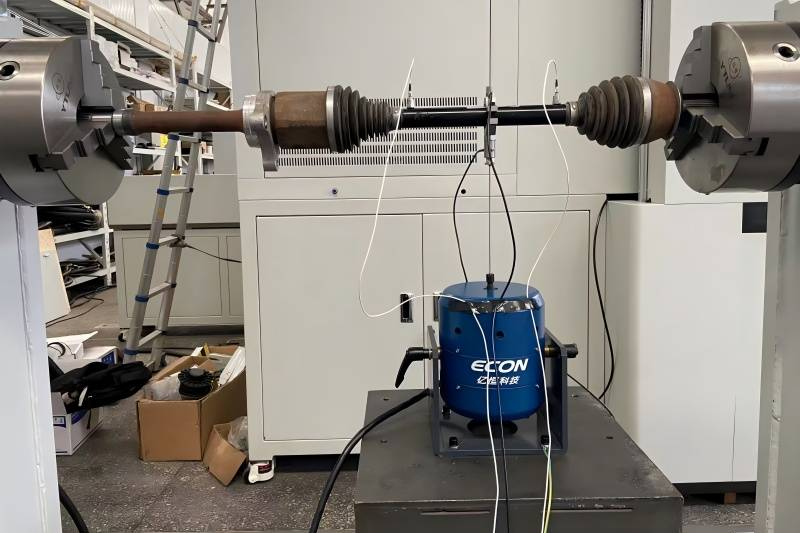
The test specimen was a production passenger vehicle drive shaft. A simplified geometric model was established to define sensor positions and to facilitate mode shape reconstruction. Both uniaxial and triaxial accelerometers were deployed along the shaft’s length, with vertical DOF responses used for modal extraction.
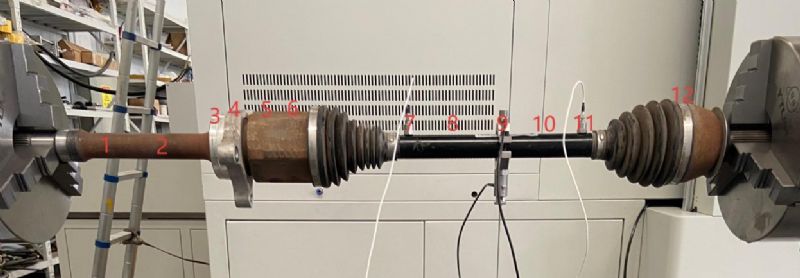
Excitation was achieved using a vibration exciter coupled with a force transducer. A multi-channel acquisition system recorded force–response FRFs under controlled excitation amplitude.
2.2 Boundary Conditions
Two boundary conditions were evaluated:
-
Free-Free Condition
The shaft was suspended using flexible supports designed to minimize constraint forces, approximating an ideal free-body configuration commonly used for intrinsic modal characterization.
-
Constrained-End Condition
One end of the shaft was mechanically clamped to replicate an installed-like stiffness boundary, introducing both translational and rotational constraints.
2.3 Modal Parameter Identification
Frequency response functions were analyzed using frequency-domain modal parameter estimation methods. Curve fitting was performed around the frequency bands corresponding to the first-order bending mode, extracting natural frequency, damping ratio, and relative mode shape vectors.
3. Results
3.1 Free-Free Boundary Condition
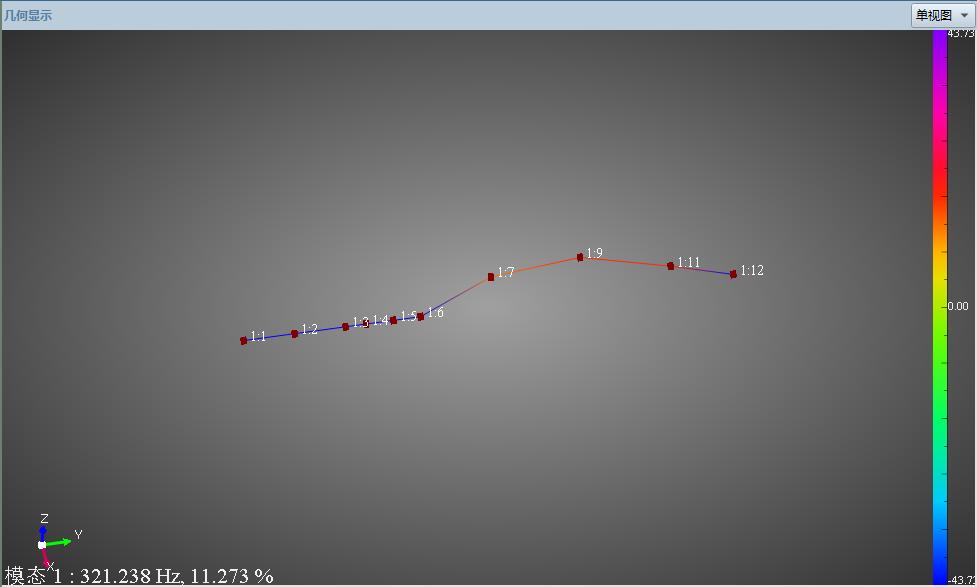
The first-order bending mode exhibited a predominantly vertical deformation pattern.
-
Natural frequency: 321 Hz
3.2 Constrained-End Boundary Condition
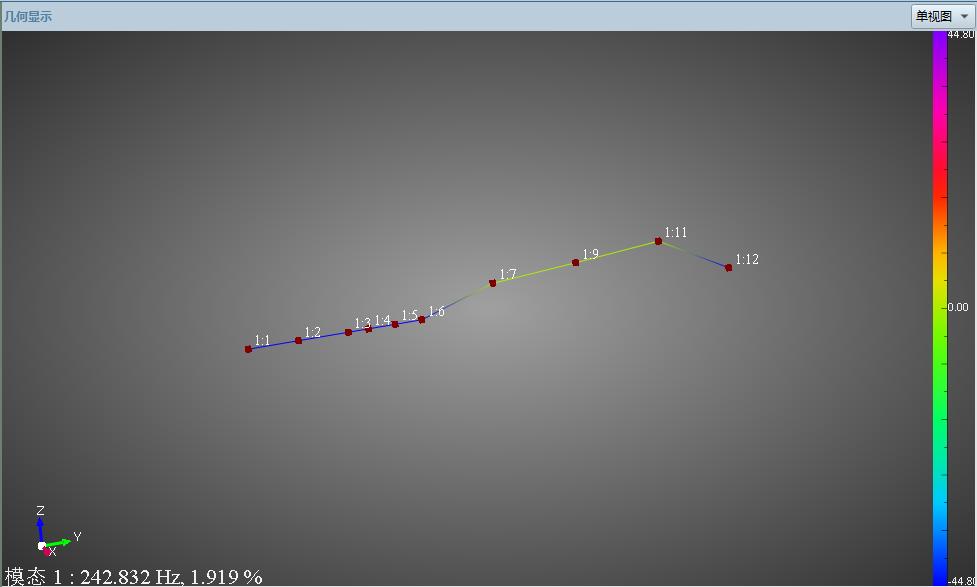
Under constrained-end support, the same bending mode was observed with altered dynamic behavior.
-
Natural frequency: 242 Hz
3.3 Comparative Interpretation
The free-free natural frequency exceeded the constrained-end value by 32.7%. This significant shift illustrates the sensitivity of slender rotating components to installation stiffness. While free-free testing isolates the inherent structural properties, constrained-end testing introduces boundary stiffness effects that are representative of practical installation environments.
4. Discussion
The comparison between free-free and constrained-end modal characteristics highlights several observations:
1. Boundary Constraints Reduce Modal Frequencies
Increased stiffness at one end introduces an effective mass loading effect, reducing the bending natural frequency.
2. Mode Shape Consistency Across Tests
The first-order mode retained a similar bending pattern across both conditions, enabling direct frequency comparison.
3. Relevance to Powertrain NVH Engineering
The constrained-end natural frequency lies closer to engine excitation orders and driveline harmonics, indicating that system-level boundary conditions must be incorporated to predict potential resonance interactions accurately.
4. Implications for Structural Design and Validation
Isolated free-free data provide useful baselines for component model validation. However, constrained-end results are indispensable when evaluating assembled-system dynamics or developing accurate finite element models for vehicle-level simulation.
5. Conclusion
This study demonstrates that boundary conditions exert a substantial influence on the dynamic properties of an automotive drive shaft. The observed 32.7% reduction in natural frequency under constrained-end conditions indicates that installation stiffness must be considered when predicting driveline resonance behavior. Incorporating both boundary-condition cases within the modal characterization workflow enhances the accuracy of NVH assessments and reduces the risk of resonance-related failures in powertrain systems.